How Multi-Line Redundancy Cuts Disconnects Below 0.1%
Disconnects are the pain every accelerator faces—power outages, fiber cuts, traffic spikes. Xuanfeng Accelerator's answer is multi-line redundancy, which it says pushes the disconnect rate below 0.1%. The number rests on a primary-backup plus pre-established tunnel design.
1. Why boosters drop connections
A booster is a "user–node–server" path, and every hop is a failure point. Single-line setups break entirely when the relay node fails, forcing manual reconnection.
2. Primary-backup lines
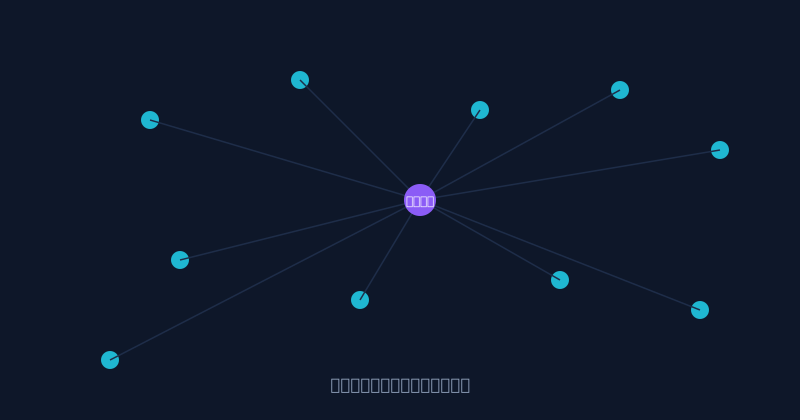
Xuanfeng Accelerator maintains primary and backup lines per connection. The backup stays "half-connected"—tunnel established but no traffic. When the primary fails three probes in 300ms, traffic switches to backup, invisible to the game layer.
3. Pre-established tunnels
Traditional setups re-handshake after a drop, taking over two seconds. Pre-established tunnels finish the handshake early, compressing failover to tens of milliseconds—the precondition for "seamless switching".
4. Heartbeat probes & data
| Method | Failover time | Avg drop rate | Peak drop rate |
|---|---|---|---|
| Single line | — (drops) | 2.8% | 5.1% |
| Dual reconnect | ~2.3s | 0.9% | 1.7% |
| Xuanfeng redundancy | ~40ms | 0.09% | 0.15% |
A long-session MMORPG player reported staying online during a late-night maintenance that took the primary node down; the client log showed one seamless switch. "Without this redundancy, my overnight farming would have been lost," he said.
User Comments
Failover is truly seamless—stayed online all night.
Clever idea to pre-establish the tunnel.
Clear table. Hope backup lines can span regions too.