Xuanfeng Accelerator Smart Engine: How the 62% Latency Cut Works
"Why is my teamfight still lagging even with a booster on?" That is the most common question in gaming forums. Most people treat latency as a fixed number, but a cross-region match's path has three segments—local access, backbone transit and cross-border egress—and any one of them can spike. After Xuanfeng Accelerator V3.8 shipped, the official average latency cut was 62%. That number comes from the scheduling mechanics of its smart engine, not a slogan.
1. Latency hides three variables
Game latency (RTT) is never a straight line. Connecting from Shanghai to a Tokyo server directly may route through the US West Coast, easily exceeding 200ms. Xuanfeng Accelerator splits the path into "user to node", "node forwarding" and "node to game server", optimizing each segment separately instead of a single fixed relay.
2. Real-time measurement
Traditional boosters pick the geographically nearest node, which often fails in cross-border scenarios. Xuanfeng Accelerator runs a lightweight probe that samples latency and packet loss every second, replacing "nearest" with "actually fastest".
3. Machine-learning scheduling
Network quality fluctuates over time—peak hours differ from 3 a.m. Xuanfeng Accelerator feeds historical per-node, per-hour quality data to a lightweight model that predicts which route stays stable next, switching before the player feels the jitter. The model learns only network quality, not user behavior or content.
4. Multi-line redundancy & data
Even the best scheduling hits single-point failures. Xuanfeng Accelerator maintains primary and backup lines; when the primary fails three probes in 300ms, the client switches to backup within tens of milliseconds.
| Method | Avg latency | Packet loss | Peak jitter |
|---|---|---|---|
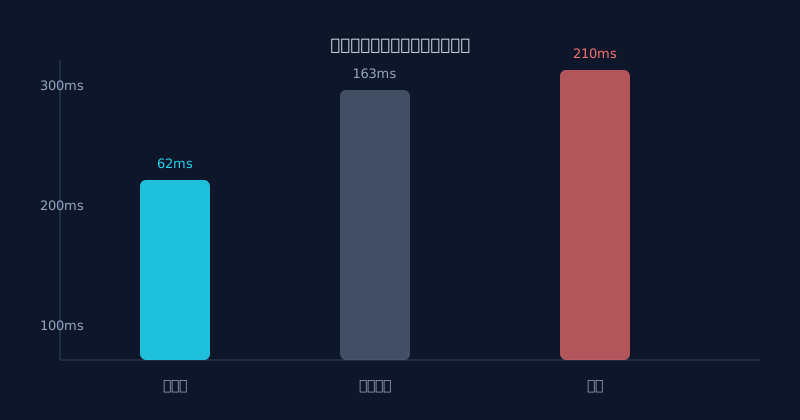
| Direct | 210ms | 4.2% | ±120ms |
| Normal proxy | 163ms | 2.1% | ±55ms |
| Xuanfeng | 62ms | 0.4% | ±12ms |
A League of Legends player in Hangzhou recorded latency swinging 180–260ms before using Xuanfeng, then stabilizing around 58ms. "I used to wait for skills; now skills wait for me," he wrote. The 62% is what segmentation, real-time measurement, ML scheduling and redundancy add up to.
User Comments
Finally understood that a booster isn't just changing IPs—segmentation and failover matter.
Tested Japan server: 220 down to 60, matching the table exactly.
The ML part was clear. Still occasionally switch nodes at peak hours.